Karl Lagerfeld and the Opéra national de Paris: A multi-sensorial, artistic collaboration
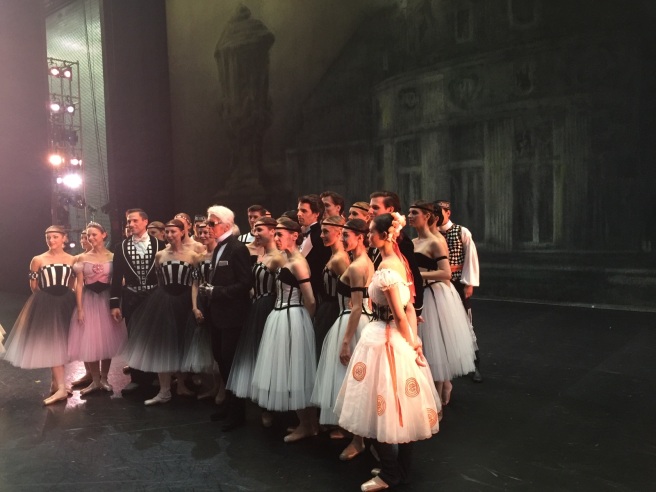
Photo by Jewel K. Goode, 2016. Karl Lagerfeld Backstage at the Opéra Bastille for George Balanchine’s Brahms-Schönberg Quartet. All Rights Reserved.
The haute couture ballet costumes and set design for George Balanchine’s Brahms-Schönberg Quartet were created by Karl Lagerfeld for the Opéra national de Paris. Renowned dancers Bart Cook and Maria Calegari served as the choreographers, and I acted as the cultural liaison and assistant to choreographers, artists, and directors. The luxurious costumes reflect an innovative, collaborative approach to fashion in the rapidly evolving globalized community. Moreover, they fully activate the five senses while providing elements of fantasy of a bygone era. For, “There will never be a world without fantasy, which expresses the unconscious unfulfilled” (S. Kaiser, 1997).
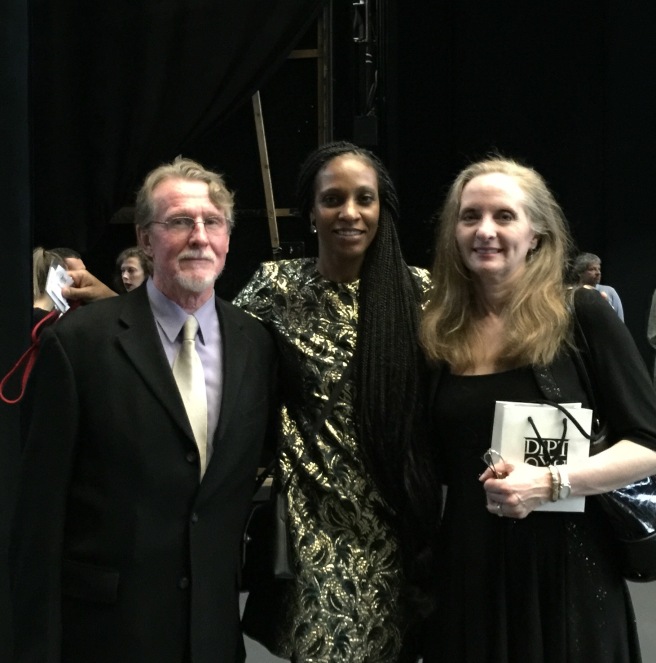
Photo by Jewel K. Goode. Jewel K. Goode with choreographers of George Balanchine’s “Brahms-Schönberg Quartet”, Bart Cook and Maria Calegari. All Rights Reserved.
This is an essential point, since art, fashion, and culture inhabit the same multi-sensorial landscape. They represent a constantly evolving visual language which must be effectively transmitted to spectators. Inaugurated in 1875, the OnP formerly represented an elitist Parisian society. The institution was historically linked to utopian images of wealth, power, prestige, and elegance. Therefore, Lagerfeld’s costume designs for each of Balanchine’s four acts needed to the encapsulate the Zeitgeit of the OnP. That essence was effectively transmitted through a consistent visual theme involving textures, costume accessories, and classical ballet silhouettes. A muted color palette of white, pale pink, and crème-orange created a bold visual juxtaposition with the monochromatic interjection of black and white details and piping. Traditionally feminine elements and curvilinear shapes were visible with velvet headpieces and armbands, satin ribbons, tulle/chiffon tutus, and bejeweled caps. These contrasted the straight lines and geometrical shapes traditionally considered masculine.
Lagerfeld conceptualized various sketches which were inspired by the Vienna Secession, an artistic movement established in 1897. Costumes were skillfully constructed in the OnP couture atelier according to Lagerfeld’s initial artistic intentions, but still allowed for subsequent modifications and adjustments of material, fabric, and accessories. Thus, costumes were individually adapted to each ballet dancer, taking into consideration rigorous choreographic maneuvers. They also accounted for other variables including lighting, sound, and stage conditions. This resulted in the creation of regal, yet fashionable costumes which contributed to the multi-sensorial landscape while integrating an advanced degree of technological innovation and functionality.
Lagerfeld’s extensive research resulted in the creation of tailored men’s black and white suede waistcoats, as well as folklore-inspired, embroidered headdresses. The women’s costumes included black and white bodices with princess seams in satin and velvet attached to voluminous tutus constructed of pink, orange, and white tulle/chiffon. Use of luxurious fabrics and detailed embroidery created a sophisticated, glamorous environment of classic, understated elegance. It also alluded to a previous era where clothing was symbolic of an individual’s social status and morality – whether actual or contrived. Lagerfeld’s set design purposefully evoked an ancient palace adorned with heavy, gray, floor-length drapery. This contrasted the color palette and texture of the costumes. Such an atmosphere was meant to reference the waning splendor of the Austro-Hungarian Empire.
Artistic collaborations between the French heritage institution and fashion have steadily increased in the globalized economy. The OnP has hosted a variety of cultural events and fashion shows such as Stella McCartney and Dries van Noten. Moreover, the OnP has collaborated with renowned fashion designers including Christian Lacroix for George Balanchine’s Le Palais de cristal, and Yves Saint-Laurent for Roland Petit’s Notre-Dame de Paris. Recently, it has begun collaborative efforts with contemporary, avant-garde fashion designers such as Iris van Herpen for Benjamin Millepied’s Clear, Loud, Bright, Forward, Alessandro Sartori for Millepied’s La nuit s’achève, and Mary Katranzou for Justin Peck’s Entre chien et loup.
Elsa Schiaparelli (1890-1973) was born into an aristocratic and intellectual family at the Palazzo Corsini in Rome, Italy. The Italian-born French couturière is best known for the quality and originality of her work infused with vibrant colors, intricate embroidery, architectural elements, bold prints, and pronounced textures. Yves Saint Laurent once commented on Schiaparelli’s profound success as an Italian in Paris: “Elle a gifflé Paris, elle l’a ensorcelé, et en retour Paris est tombé amoureux d’elle” (Baxter-Wright, p. 27). She brought an Italian sensibility to French haute-couture with cleverness, whimsy, femininity, and expertise. In addition, artistic collaboration with others allowed Schiaparelli to skillfully implement innovative techniques, materials, and various genres into her idiosyncratic designs.
Schiaparelli was oftentimes regarded as an artist as much as a designer. Gabrielle (Coco) Chanel’s statement reflects this sense of artistry, “… cette artiste italienne qui fait des vêtements (Baxter-Wright, p. 71). Schiaparelli soon caught the attention of renowned fashion design Paul Poiret, as well as Gabrielle Picabia, wife of Dadaist painter Francis Picabia. Her early work produced at the atelier in rue de l’Université consisted of geometrical designs and was considerably more conservative than later years. By 1927, Schiaparelli was catapulted to success with the creation of a hand-knit sweater with a black and white trompe l’oeil motif. It was immediately deemed an “artistic masterpiece” by Vogue and launched her career. This eventually led to the opening of her atelier on 4, rue de la Paix, “Schiaparelli – Pour le Sport” with designs seamlessly blending haute-couture and sportswear.
Schiaparelli’s spirit of entrepreneurialship and business acumen were apparent very early, as she surrounded herself with creative talents including: Meret Oppenheimer, Alberto Giacometti, Lesage, Jean Schlumberger, Lina Baretti, Jean-Michel Frank, Roger Vivier, and Marcel Vertès, among many others. Schiaparelli was the first woman to be featured on the cover of Time magazine in 1934. This marked the beginning of Schiaparelli’s experimentation with jewelry design, various motifs, aerodynamic cuts, intricate embroidery, bold colors, and innovative materials such as Swarowsky crystals, rhodophane, and crushed rayon crepe. Rhodophane is a transparent and fragile material which appears like glass, while crushed rayon crepe resembles tree bark. Her fragrance “S” was launched in 1928. Soon thereafter, a collection of three perfumes, Souci, Salut, and Schiap, was created in 1934. Schiaparelli’s designs attracted strong, independent women, as well as famous customers such as Katherine Hepburn, Marlene Dietrich, Greta Garbo, Lauren Bacall, Vivien Leigh, and Wallis Simpson, the future Duchess of Windsor. Her designs were lauded for celebrating, not neglecting, the feminine form with nipped-in tops, bold lines, and skirts to flatter the real woman. Schiaparelli once commented, “Il ne faut pas adapter le vêtement au corps, mais faire en sorte que le corps s’adapte au vêtement” (Baxter-Wright, p. 89). In 1932, the Couture House was known as “Schiaparelli – Pour le Sport, Pour le Ville, Pour le Soir”, and later moved into its current location Hôtel de Fontpertuis at 21 place Vendôme in 1935.
Schiaparelli was continually inspired by illustrations, architecture, fantasy, the Italian Commedia dell’Arte, and the theatricality of Surrealism. During this period, she often collaborated with artists. She and Salvador Dalì created several controversial pieces, including “Squelette” (Skeleton Dress, 1938), and “Homard” (Lobster Dress, 1937), a recurrent theme in Dalì’s work which often had sexual connotations. It features a large, blood-red lobster motif on a simple, white dress, strategically located between the thighs. “Larmes” (Tears Dress, 1938) is part of the “Cirque” collection inspired by Dalì’s “Trois jeunes femmes surréalistes tenant dans leurs bras les peaux d’un orchestra” (1936). Designed just before the outbreak of World War II, the silk crêpe dress was created as a “mourning dress”, accompanied by a long veil and tears in a trompe l’oeil motif. Schiaparelli states, “Quand les temps sont difficile, la mode est toujours outrancières” (Baxter-Wright, p. 79). Other notable collaborations were with Jean Cocteau, whose drawings were featured on many of her designs, René Magritte (for the fragrance bottle inspired by his “Ceci n’est pas une pipe” painting), and Man Ray throughout the 1930’s and 1940’s.
Schiaparelli was able to skillfully translate the utopian, dreamlike state of Surrealist imagery into her innovative designs, and was the first to give her collections a theme. Some of the clothes from this period included, “Stop, Look, and Listen” (1935), “Paris in 1937” (1937), and “Music” (1937). “Zodiac”, “Pagan”, and “Circus” were all created in 1938, and “Commedia dell’Arte” was created shortly thereafter (1939). Schiaparelli also served as costume designer for various Hollywood films including “Every Day’s a Holiday” (1937) and “Moulin Rouge” (1952). Much of her success was due to an ability to conceptualize and execute a broad range of items including bathing suits, sportswear such as the jupe-culotte, evening gowns, wrap dresses, hats, jewelry, and perfume.
Perhaps most significant was the creation of her Shocking perfume and “shocking pink” trademark color in 1937. Commenting on the color, Schiaparelli once stated: “Une couleur qui donne la vie, la couleur de toute la lumière du monde, de tous les oiseaux et de tous les poisons du monde réunis, une couleur de la Chine de du Pérou, mais pas de l’Occident » Baxter-Wright, p. 48). The perfume bottle was designed by Leonor Fini, and represented a dressmaker mannequin referencing the physique of Mae West decorated with porcelain flowers and a velvet measuring tape. The Maison Schiaparelli proved to be an international success, and Elsa became the first European to receive the Nieman Marcus Award for services to fashion in 1940. However, this marked a period of decline for the House of Schiaparelli, and it was forced to close in 1954, the same year her autobiography, Shocking Life, was released.
Nearly fifty years later, the Schiaparelli archives and rights were acquired by Diego della Valle in 2006. Subsequently, the Maison Schiaparelli reopened at stately Hôtel Fontpertuis on 21, place Vendôme in 2012. As a tribute to the original founder, Christian Lacroix designed an haute-couture collection one year later. Soon thereafter, Farida Khelfa was appointed Ambassador, and Marco Zanini was appointed creative director in 2013. In January 2014, the Maison Schiaparelli successfully presented its first haute-couture show at Hôtel Fontpertuis since its 1954 closing. By re-contextualizing and reconfiguring particular elements, Zanini was able to capture the essence of Maison Schiaparelli – transforming it into a contemporary, yet timeless, brand with Italian-Parisian sensibilities. The Théâtre d’Elsa references 1930’s Parisian theatres. It is a chic, cosmopolitan realm encapsulated in elegance, splendor, and glory.
Designs consisting of bold, masculine silhouettes, tweeds, and tartans draped over full, opulent gowns made of shimmering rhodophane creates a sense of restrained elegance. However, there is also a strategic use of vibrant, saturated colors, and well as the trademark “shocking pink”. Flowing, luxurious fabrics, and the appearance of hand-painted prints on silk chiffon and organdy point to the complexity and detail of the couturière method. These pieces are carefully juxtaposed with structured capes with strong shoulders, bold, architectural shapes, and intricate embroidery reminiscent of Spanish boleros. Complex details and embroidery appearing on the back add another dimension to the idiosyncratic creations. Sparkling, oversized brooches consisting of pierced hearts, irises, suns, stars, padlocks, and the ES initials illuminate each colorful ensemble. The totality of the Fall/Winter 2015-2016 collection reflects a masterful re-interpretation and re-contextualization of Elsa Schiaparelli’s twentieth century designs by Marco Zanini.


 Jewel K. Goode