Élisabeth Louise Vigée Le Brun: Portraits of Marie-Antoinette and Courtly Life

Élisabeth Louise Vigée Le Brun: Portraits of Marie-Antoinette and Courtly Life

Élisabeth Louise Vigée le Brun still remains a relatively unknown female artist belonging to the Age of Enlightenment despite having achieved many notable successes. Born in 1755 during the reign of Louis XV, Vigée le Brun was raised in a family of artists who introduced her to the world of painting and fine art. She is perhaps most renowned for her portraits of Marie-Antoinette.  However, she was never fully celebrated in France until the 21st century when the Grand Palais devoted an entire exhibition to the artist and her work.
Jewel Goode Marie Antoinette 1
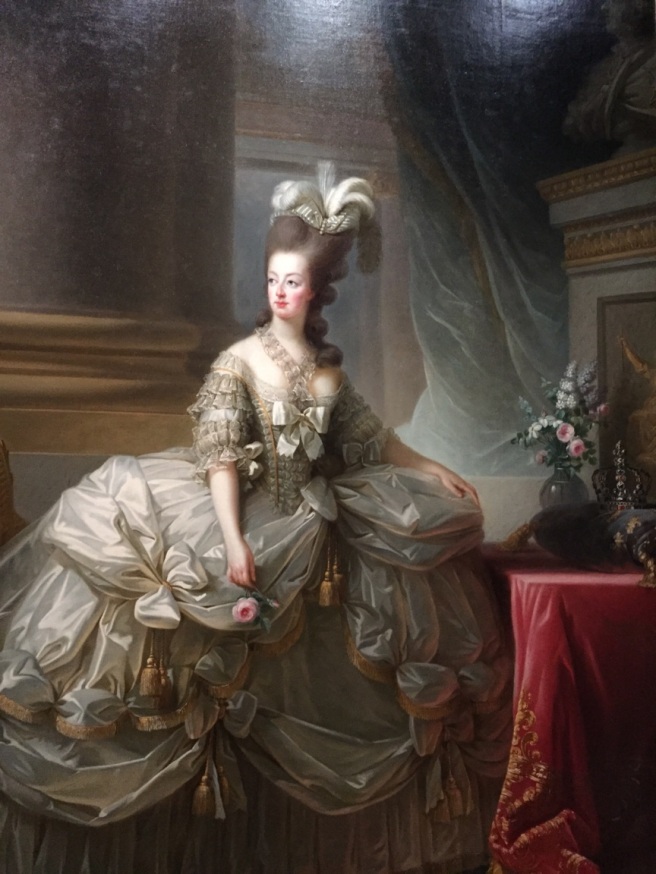
Marie-Antoinette en grand habit de cour (1778). Photo by Jewel Goode, 2015. All Rights Reserved.

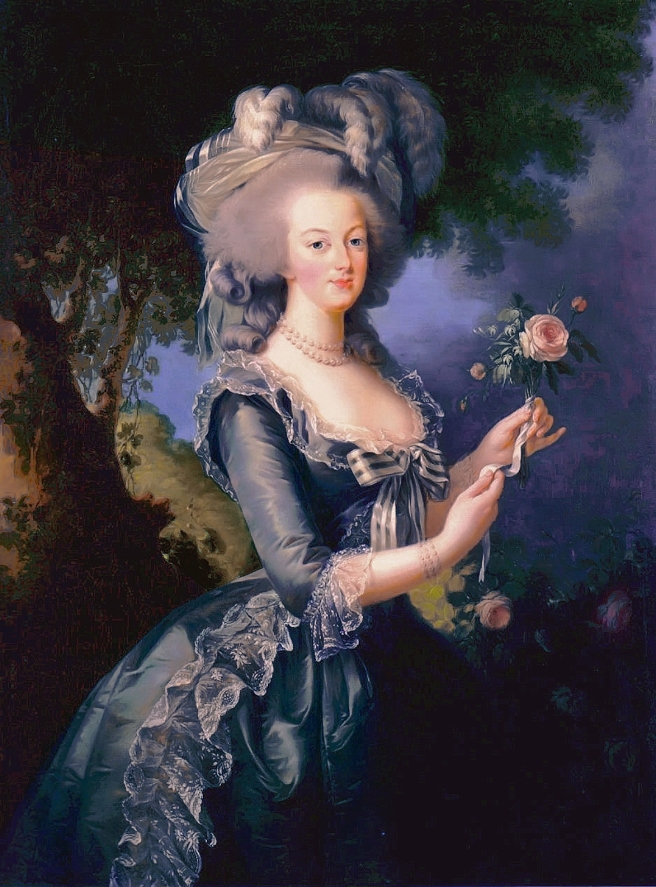
Vigée Le Brun’s idealized representations of the Queen offer an innocent, serene, and spiritual interpretation of courtly life while highlighting the essence of royalty.  Marie-Antoinette en grand habit de cour (1778) was the artist’s first official portrait which shows the Queen en grand panier.  She is dressed in a voluminous, luxurious, white satin gown with exquisite golden tassels and trimming as her gaze is averted to the right.  Her intricate lace bodice with princess seams and three-quarter length sleeves is carefully adorned with white, satin bows.  This whiteness mirrors the paleness of her translucent, white flesh.  A sophisticated feather hat sits atop Marie-Antoinette’s elegant coiffure.  The Queen’s stance is both intimidating and gracious as she poses in the corner of a stately room holding one pink rose. Her crown rests inconspicuously upon a purple cushion embroidered with golden fleur-de-lis.  It is situated next to a vase of pale pink, purple, and white flowers.
Decorative Arts 3
Élisabeth Vigée Le Brun, Marie-Antoinette à la rose (1783)

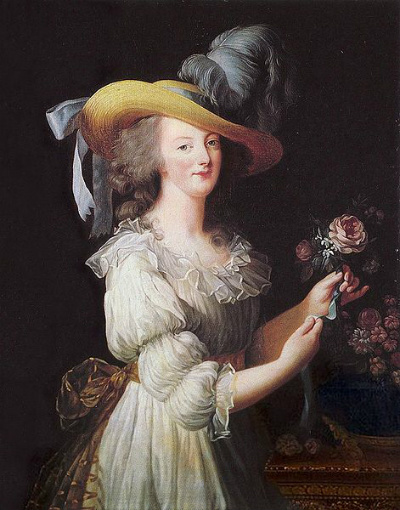
During this time, 18th century women began to opt for the robe chemise in mousseline cotton which did not require an obtrusive panier.  These simplified garments were designed from one piece of fabric.  They were preferred for their comfort and ease of movement. Vigée Le Brun’s portrait of Marie-Antoinette, La reine vêtue d’une robe chemise, was shown at the 1783 Salon, an exhibition space for the Royal Academy.  The Queen appears in a white, cotton “peasant dress” with a transparent, golden sash tied around her waist.  Her relaxed curls are topped by a simple, straw-feathered hat with blue satin ribbon.  She fixes her soft gaze upon the spectator as she arranges a simple bouquet of flowers in her delicate hands.
Decorative Arts 2
Marie-Antoinette en gaulle (1783).  Photo by Jewel Goode, 2015. All Rights Reserved.

Despite its charm, the portrait was deemed inappropriate and offensive by many due to the severe informality of a dress meant to be worn in the privacy of one’s boudoir.   It was soon replaced by Marie-Antoinette à la rose, showing the queen in more traditional courtly attire.
Marie Antoinette et ses enfants Grand Palais
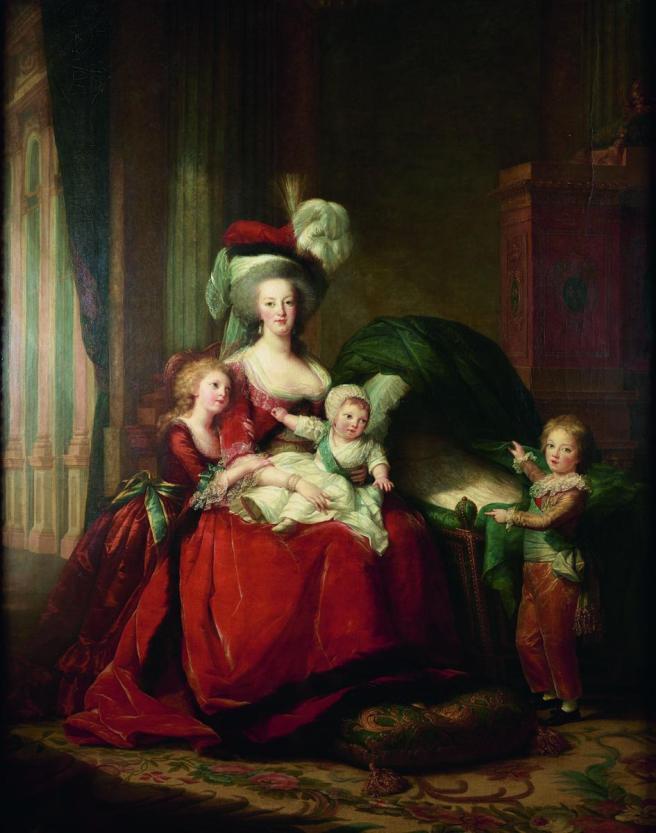
Élisabeth Vigée Le Brun, Marie -Antoinette et ses enfants (1787)

In 1785, Vigée Le Brun was commissioned to paint a monumental portrait of the Queen.  The portrait was to highlight the maternal characteristics of the Queen by having her appear with her three children.  Marie-Antoinette et ses enfants (1787) shows a serene, benevolent Queen comfortably seated in a chair.  Her feet rest upon a green cushion embroidered with golden arabesques.  These same arabesques are mirrored in the multicolored Persian rug.  Marie-Antoinette is clothed in red, stately, full-length gown with plunging décolleté edged in delicate white lace.  Atop her simple coiffeur sits a stylish, red hat with white feathers and blue satin ribbon.  Her outward gaze is confident, yet tranquil, as she loving embraces a restless baby on her lap, clothed in a white cap and gown with blue sash.

A blond-haired daughter with cherubic features, dressed in a similar velvet red gown with satin bows in blue and gold, lovingly gazes upward as she wraps her arms around her mother’s right arm.  The third child is also elegantly clothed in a red velvet pant suit with white lace collar and blue satin sash. This piercing blue is reflected in every figure’s eyes.  The child stands proudly next to a royal bassinet heavily draped in a deep, forest-green satin.  The ensemble of voluminously-clothed figures is prominently arranged in a pyramidal form.  This is in direct contrast to strong vertical lines created by the architectural columns and wooden cabinet situated in the background.

Due to the success of Marie-Antoinette en grand habit de cour, Vigée Le Brun was invited to paint a series portraits of the Queen.  By varying the accessories, clothing, poses, and environment, the artist successfully highlighted certain inimitable characteristics of the Marie-Antoinette’s complex personality.  This included her natural grace, elegance, and confidence.  Vigée Le Brun’s portraits of the Queen also provided clear, invaluable insight into sociocultural norms which were visibly reflected in the representation of acceptable courtly attire.

Author: Jewel K. Goode
Jean-Honoré Fragonard: Inspiration for Karl Lagerfeld’s Chanel Haute Couture Spring 2017 Collection

Jean-Honoré Fragonard: Inspiration for Karl Lagerfeld’s Chanel Haute Couture Spring 2017

karl-lagerfeld-haute-couture-2017-a
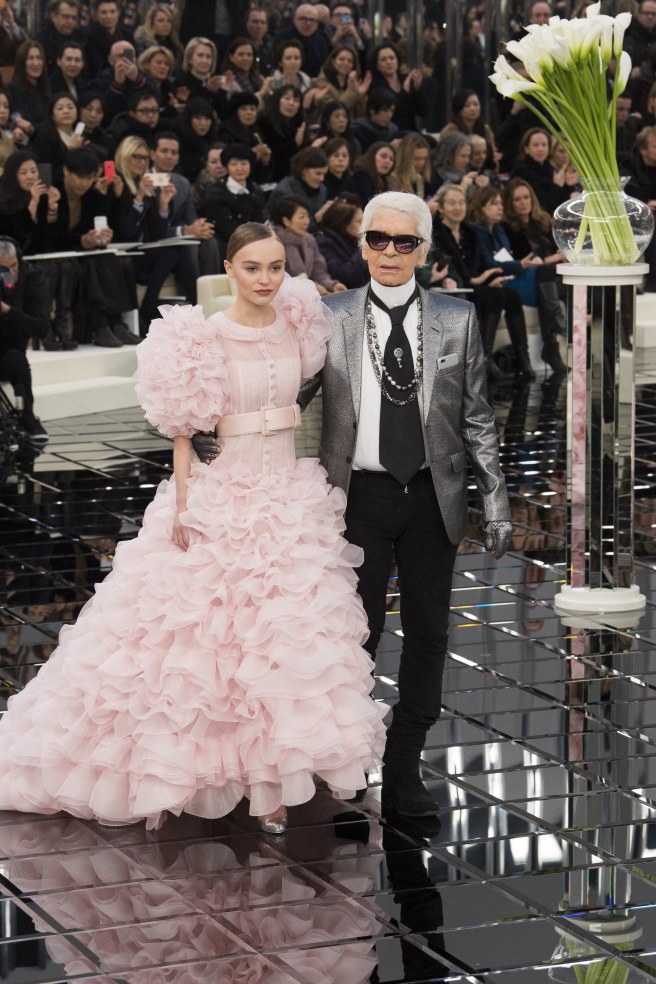
Karl Lagerfeld’s Chanel Haute Couture Spring 2017 Collection. Photo by Yannis Vlamos, 2017. Indigital.tv

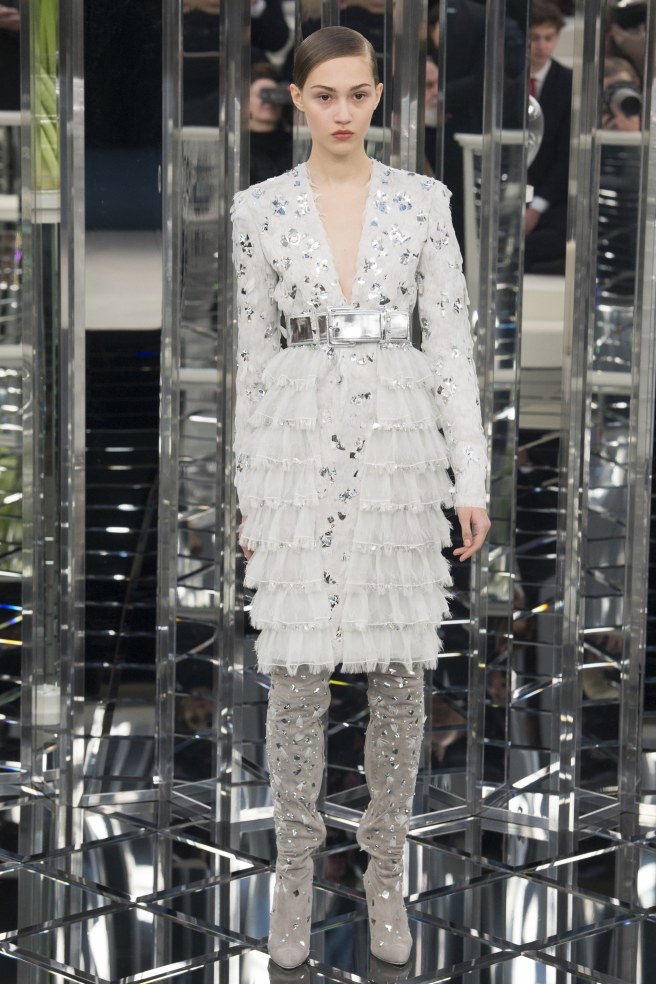
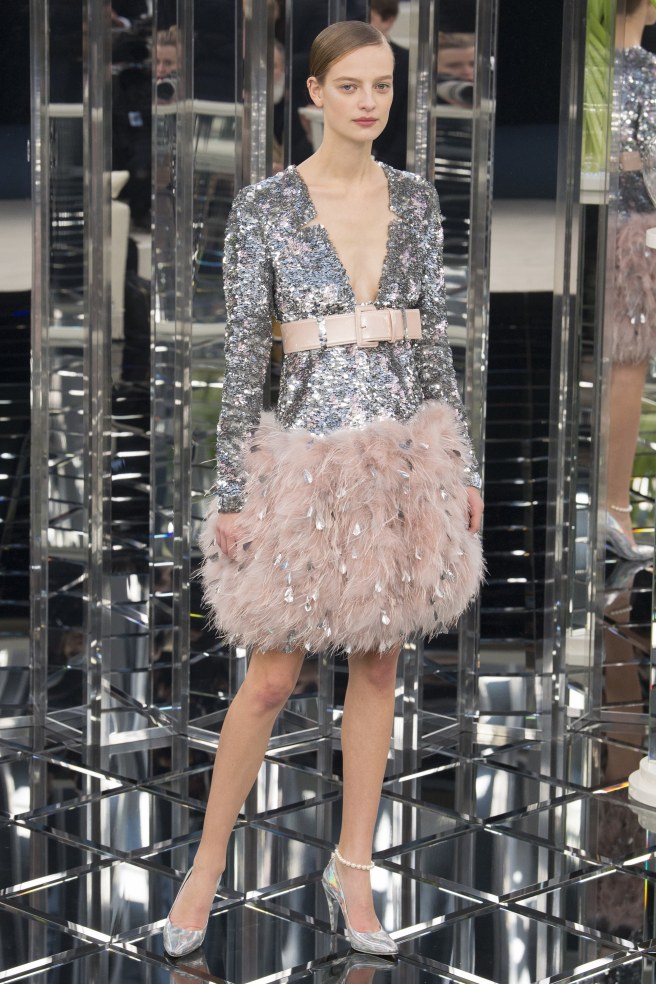
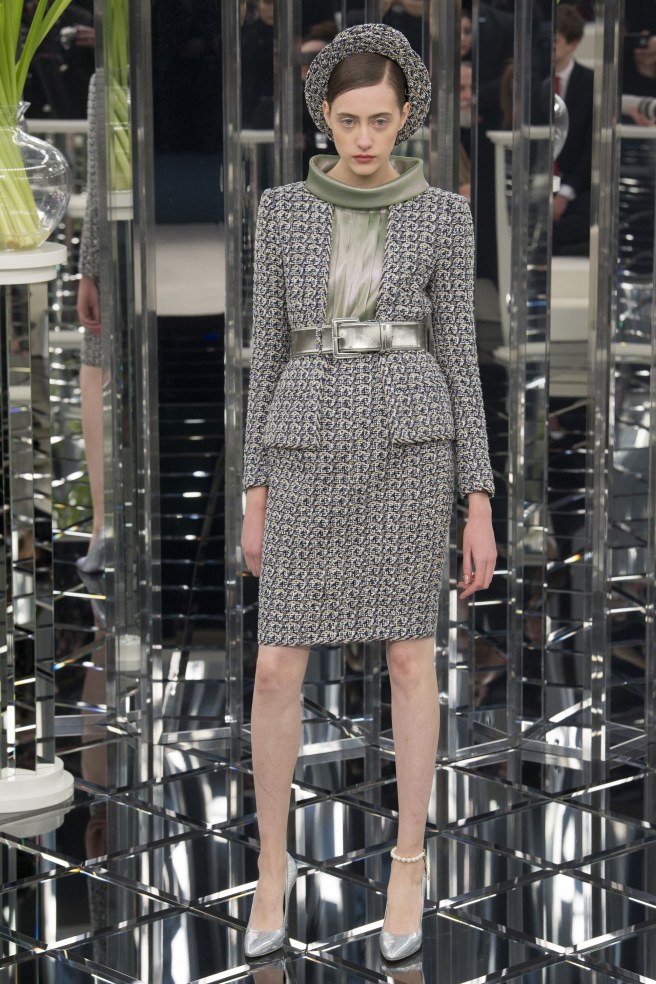
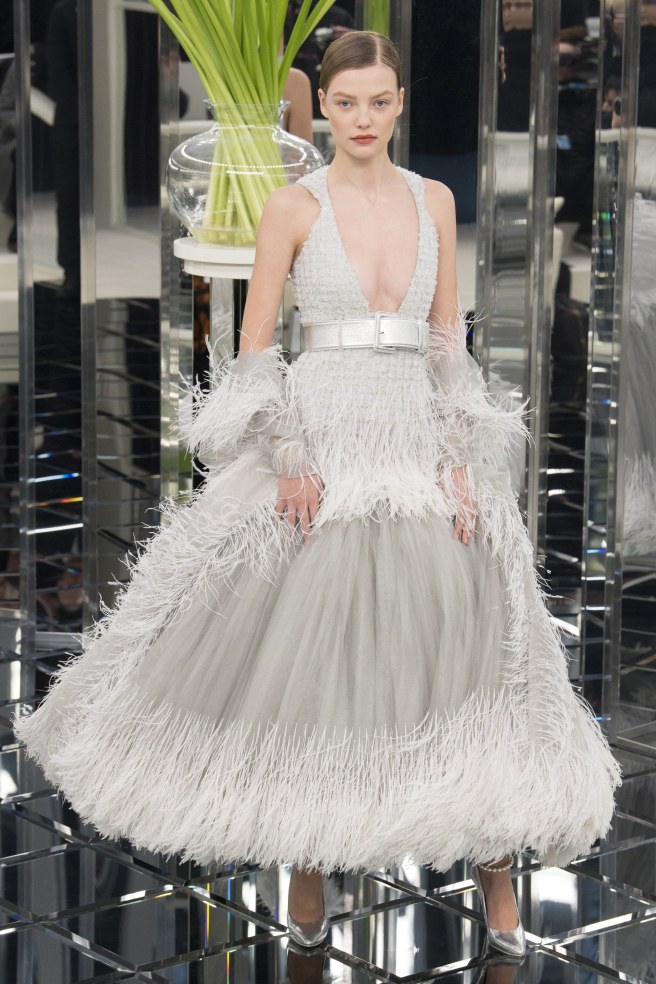
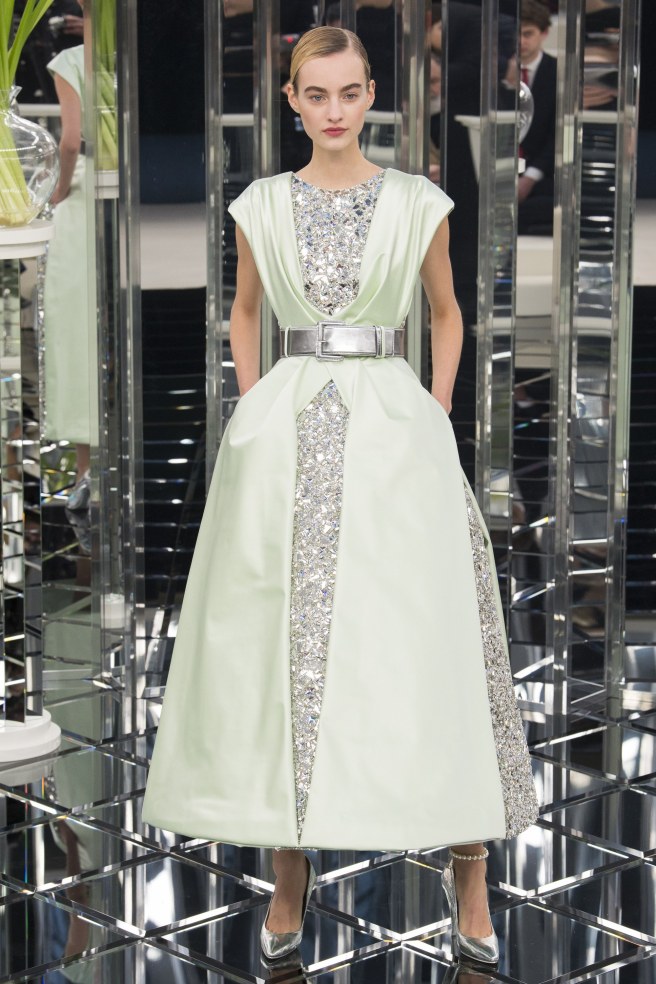
Karl Lagerfeld’s Chanel Haute Couture 2017 collection, held in January 2017 at the Grand Palais in Paris, France, was a study in elegance, femininity, and sophistication.  The line visibly referenced Le Colin-Maillard (1754-1756), or Blind Man’s Bluff, an eighteenth-century chef-d’oeuvre by French painter, Jean-Honoré Fragonard. Similar to Fragonard, who painted a variety of subjects including landscapes, genres, historical, grand interiors, portraits, mythological tales of Antiquity, Lagerfeld’s Haute Couture 2017 reflected the same level of diversity.  The Chanel collection combined luxurious materials such as silk, satin, and chiffon.  Long, lean silhouettes were created with cinched-in waists, high-waisted trousers, and gentle A-line skirts.   The subdued color palette of cream, shades of pale pink and yellow, and beige were gently anchored with silver and gold accessories or ostentatiously highlighted with a profusion ruffles, feathers, paillettes, and embroidery.

karl-lagerfeld-chanel-haute-couture-d
Karl Lagerfeld’s Chanel Haute Couture Spring 2017 Collection.  Photo by Yannis Vlamos, 2017.  Indigital.tv

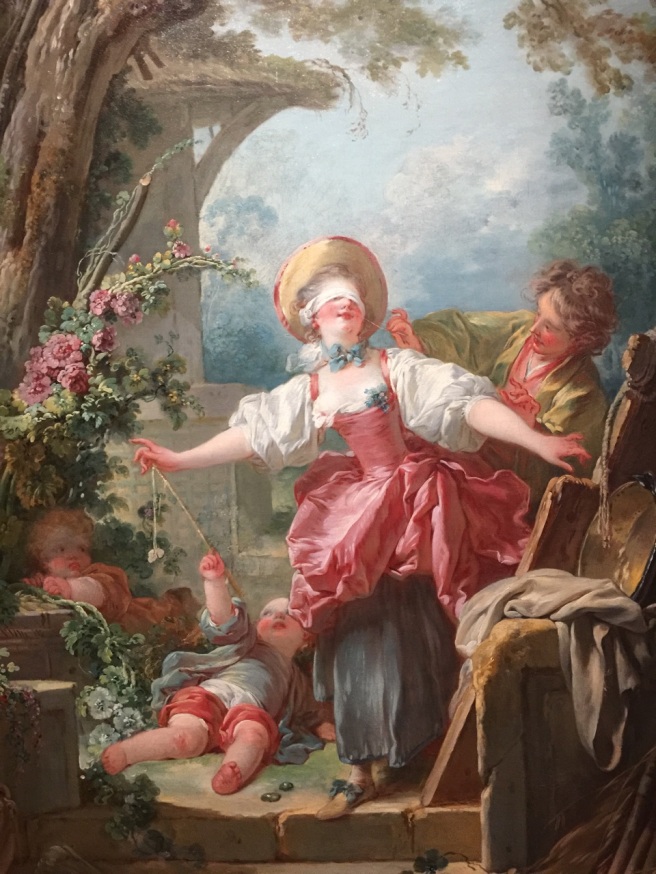
Lagerfeld masterfully utilizes classic Chanel iconography primarily consisting of wool and tweed while cleverly implementing the same libertinage themes as Fragonard.  The superfluous, licentious style was pervasive during the Enlightenment.  Although viewed as blatantly hedonistic, romance, sensuality, and utopian pastoral scenes were artificially disguised as gallantry within the context of a modernized society. This ultimately created a complete fragmentation and detachment from its supposed sentiment.  Le Colin-Maillard was Fragonard’s first foray into pastoral paintings.  He utilizes a soft color palette including pink, blue, white, green, and yellow to evoke an erotically-charged, pastoral environment popular amongst the aristocracy. The scene evokes a lush, flowering pastoral scene framed by a soft blue sky. It is a flirtatious, sensual setting in which a young shepherdess wearing fashionable, rustic attire playfully peeks through the bandage covering her eyes, presumably placed there by her lover.

karl-lagerfeld-chanel-haute-couture-2017-d
Karl Lagerfeld’s Chanel Haute Couture Spring 2017 Collection.  Photo by Yannis Vlamos, 2017.  Indigital.tv

Lagerfeld borrows the elegant shepherdess of Fragonard’s Le Colin-Maillard and recontextualizes the figure as an haute-couture model.  In both genres, she is the dominant, central figure.  Positioned in a gentle contrapposto, the twenty-first century model and eighteenth-century shepherdess animate the scene/defilé with graceful, elegant movements. The voluminous fabric of Lily-Rose Depp’s pink, chiffon dress is illuminated by a soft, gentle light originating from above. Fragonard’s blond-haired heroine with undulating curls dons an unassuming straw hat tipped in pink, while those of Lagerfeld’s models sit atop sleek chignons.

karl-lagerfeld-chanel-haute-couture-2017
Karl Lagerfeld’s Chanel Haute Couture Spring 2017 Collection.  Photo by Yannis Vlamos, 2017.  Indigital.tv

Throughout the defilé, it is evident that Lagerfeld’s Chanel haute couture line is inspired by Le Colin-Maillard’s shepherdess juxtaposed with contemporary society.  Her white, billowing, cotton sleeves mirror the whiteness of the eye bandage, as well as the undergarments covering her bosom. Delicate pink chiffon contrasts the grayish-blue silk undergarment extending to her ankles. This blue is mirrored in the shepherdess’s satin ribbon shoelaces.  The delicate bunch of wildflowers tucked into her bosom, and the wispy ribbon which adorns her neck, encapsulate the romantic essence of Lagerfeld’s haute couture défilé.

karl-lagerfeld-chanel-haute-couture-f
Karl Lagerfeld’s Chanel Haute Couture Spring 2017 Collection.  Photo by Yannis Vlamos, 2017.  Indigital.tv

The implementation of the chiaroscuro technique, strategically executed with mirrors and lights, provides strong visible juxtapositions between two distinct realms.  A contrived, neoclassical/Art Déco sphere with glass pedestals and mirrored floors contrasts with romantic, luxurious colors, fabrics, and textures. The former being solid, weighted, and rigid; the latter being light, voluminous, and lush. This concept is evident with both Lagerfeld’s and Fragonard’s selection of materials, soft color palette, and positioning of architectural objects.

karl-lagerfeld-chanel-haute-couture-2017-e
Karl Lagerfeld’s Chanel Haute Couture Spring 2017 Collection.  Photo by Yannis Vlamos, 2017.  Indigital.tv

Similar to the painting, strong diagonals are formed during the défilé – created by light sources emanating from above. Vertical and horizontal divisions are distinct throughout Lagerfeld’s clever mise-en-scène which utilizes mirror refraction. Strong, architectural lines and obliques created by the glass pedestals and mirrored floors contrast the lushness created by the profusion ruffles, feathers, paillettes, and embroidery.  Wildflowers, trees, ivy, and billowing fabric adorning Fragonard’s shepherdess create a utopian arrière-plan.

About Jean-Honoré Fragonard

Born in Grasse, Fragonard (1732-1806), or “Frago”, is one of the most influential painters of the eighteenth century, especially during the years preceding the French Revolution.  Fragonard began his training as a painter with Jean-Baptiste Chardin and later with François Boucher.  Soon thereafter, he was recipient of the Grand Prix award in 1752 which subsequently led to his acceptance into the Royal Academy of Painting in 1765.  A series of important paintings were commissioned over the course of his lifetime including L’Aurore triumphant de la Nuit (1755), Le Verrou (1775), Le Jeu de la main chaude (1775), and Renaud entre dans la forêt (1761).

Jewel K. Goode
Jean-Honoré Fragonard, Le Colin-Maillard. Photo Jewel K. Goode, 2015. All Rights Reserved.

Author: Jewel K. Goode

Sources

Faroult, Guillaume. Album de l’exposition du Musée du Luxembourg. Fragonard amoureux: Galant et libertin. Réunion des musées nationaux – Grand Palais, 2015.

Karl Lagerfeld and the Opéra national de Paris: A multi-sensorial, artistic collaboration

Karl Lagerfeld and the Opéra national de Paris: A multi-sensorial, artistic collaboration

jewel-goode-opera-balanchine-pg-lagerfeld-and-dancers
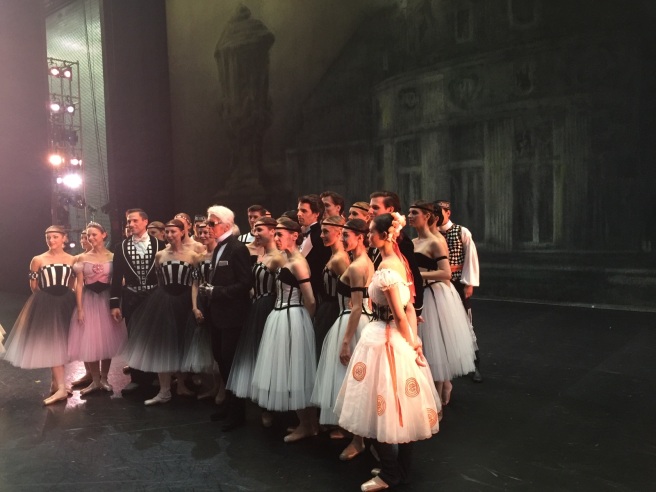
Photo by Jewel K. Goode, 2016. Karl Lagerfeld Backstage at the Opéra Bastille for George Balanchine’s Brahms-Schönberg Quartet. All Rights Reserved.

The haute couture ballet costumes and set design for George Balanchine’s Brahms-Schönberg Quartet were created by Karl Lagerfeld for the Opéra national de Paris.  Renowned dancers Bart Cook and Maria Calegari served as the choreographers, and I acted as the cultural liaison and assistant to choreographers, artists, and directors.  The luxurious costumes reflect an innovative, collaborative approach to fashion in the rapidly evolving globalized community.  Moreover, they fully activate the five senses while providing elements of fantasy of a bygone era.  For, “There will never be a world without fantasy, which expresses the unconscious unfulfilled” (S. Kaiser, 1997).

jewel-goode-opera-national-de-paris-balanchine-premiere-with-bart-cook-and-maria-calegari
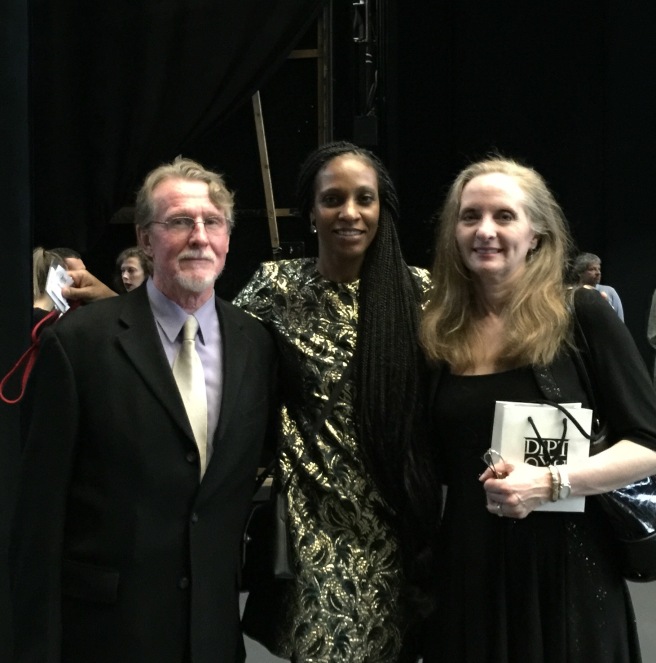
Photo by Jewel K. Goode.  Jewel K. Goode with choreographers of George Balanchine’s “Brahms-Schönberg Quartet”, Bart Cook and Maria Calegari.  All Rights Reserved.

This is an essential point, since art, fashion, and culture inhabit the same multi-sensorial landscape.  They represent a constantly evolving visual language which must be effectively transmitted to spectators. Inaugurated in 1875, the OnP formerly represented an elitist Parisian society.  The institution was historically linked to utopian images of wealth, power, prestige, and elegance. Therefore, Lagerfeld’s costume designs for each of Balanchine’s four acts needed to the encapsulate the Zeitgeit of the OnP.  That essence was effectively transmitted through a consistent visual theme involving textures, costume accessories, and classical ballet silhouettes.  A muted color palette of white, pale pink, and crème-orange created a bold visual juxtaposition with the monochromatic interjection of black and white details and piping.  Traditionally feminine elements and curvilinear shapes were visible with velvet headpieces and armbands, satin ribbons, tulle/chiffon tutus, and bejeweled caps.  These contrasted the straight lines and geometrical shapes traditionally considered masculine.

Lagerfeld conceptualized various sketches which were inspired by the Vienna Secession, an artistic movement established in 1897. Costumes were skillfully constructed in the OnP couture atelier according to Lagerfeld’s initial artistic intentions, but still allowed for subsequent modifications and adjustments of material, fabric, and accessories.  Thus, costumes were individually adapted to each ballet dancer, taking into consideration rigorous choreographic maneuvers.  They also accounted for other variables including lighting, sound, and stage conditions.  This resulted in the creation of regal, yet fashionable costumes which contributed to the multi-sensorial landscape while integrating an advanced degree of technological innovation and functionality.

Lagerfeld’s extensive research resulted in the creation of tailored men’s black and white suede waistcoats, as well as folklore-inspired, embroidered headdresses.  The women’s costumes included black and white bodices with princess seams in satin and velvet attached to voluminous tutus constructed of pink, orange, and white tulle/chiffon.  Use of luxurious fabrics and detailed embroidery created a sophisticated, glamorous environment of classic, understated elegance.  It also alluded to a previous era where clothing was symbolic of an individual’s social status and morality – whether actual or contrived.  Lagerfeld’s set design purposefully evoked an ancient palace adorned with heavy, gray, floor-length drapery.  This contrasted the color palette and texture of the costumes.  Such an atmosphere was meant to reference the waning splendor of the Austro-Hungarian Empire.

Artistic collaborations between the French heritage institution and fashion have steadily increased in the globalized economy.   The OnP has hosted a variety of cultural events and fashion shows such as Stella McCartney and Dries van Noten.  Moreover, the OnP has collaborated with renowned fashion designers including Christian Lacroix for George Balanchine’s Le Palais de cristal, and Yves Saint-Laurent for Roland Petit’s Notre-Dame de Paris.  Recently, it has begun collaborative efforts with contemporary, avant-garde fashion designers such as Iris van Herpen for Benjamin Millepied’s Clear, Loud, Bright, Forward, Alessandro Sartori for Millepied’s La nuit s’achève, and Mary Katranzou for Justin Peck’s Entre chien et loup.

Author: Jewel K. Goode 

Postcards: Paris

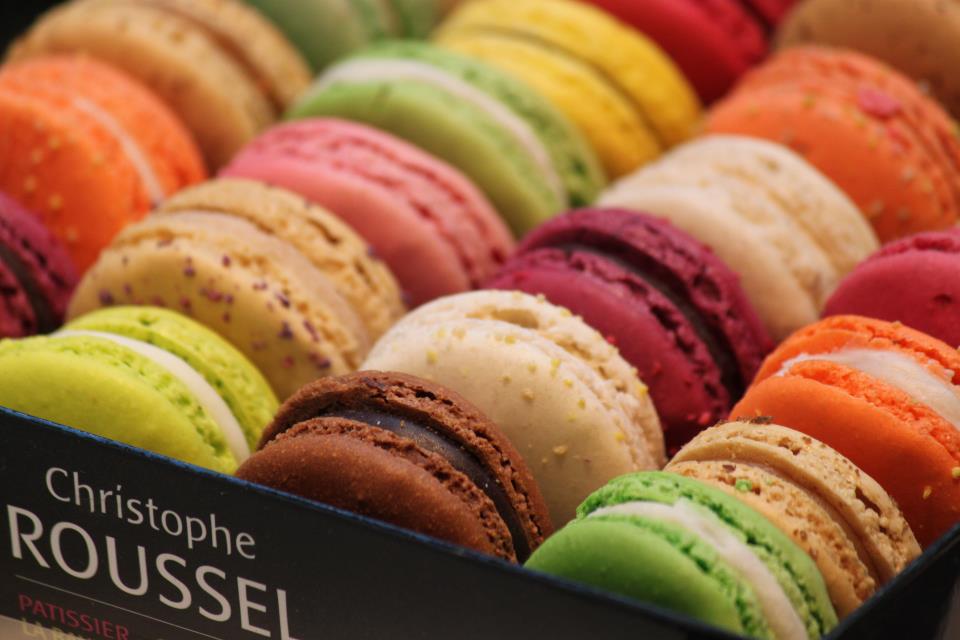
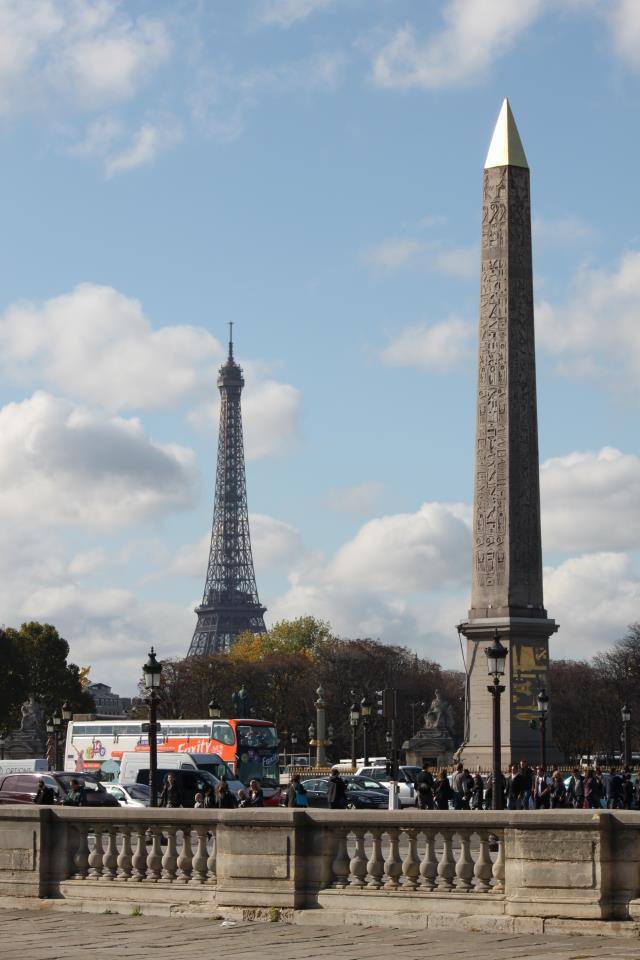
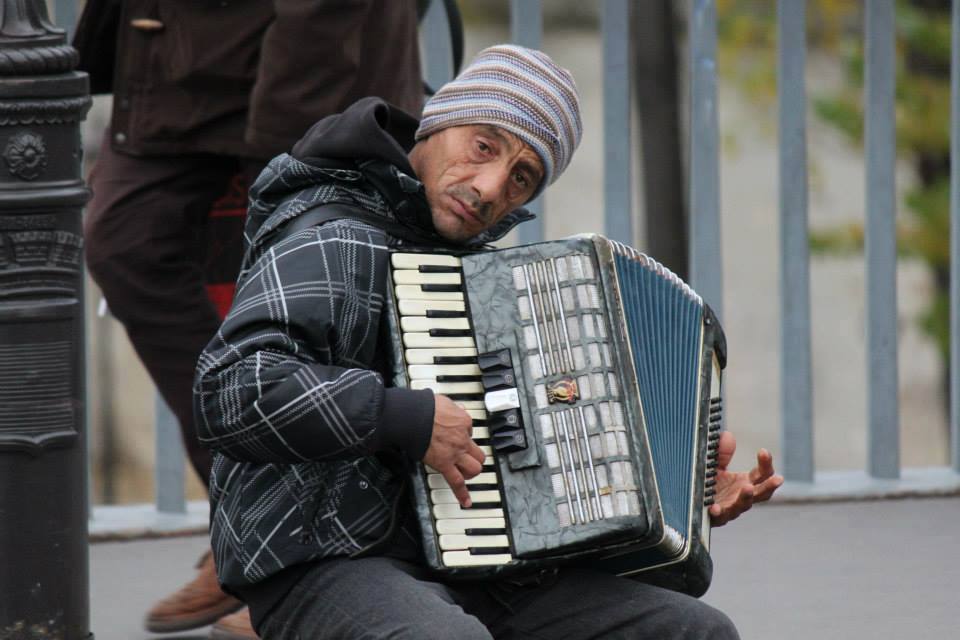
Paris, France

Paris, France. © Jewel Kismet Designs, 2011. All Rights Reserved.


Paris, France. © Jewel Kismet Designs, 2013. All Rights Reserved.


Paris, France. © Jewel Kismet Designs, 2012. All Rights Reserved.