Paris Reflections: Fall Edition N.5, Musée du Luxembourg Exhibition, “Fragonard amoreux: Galant et libertin”

Paris Reflections: Fall Editions N.5, Musée du Luxembourg Exhibition.  “Fragonard amoureux: Galant et libertin”

Jean-Honoré Fragonard, Le Colin-Maillard (1754). Photo © Jewel K. Goode, 2015. All Rights Reserved.
Jean-Honoré Fragonard, Le Verrou (1775). Photo © Jewel K. Goode, 2015. All Rights Reserved.

The exhibition Fragonard amoureux: Galant et libertin (Fragonard in Love: Suitor and Libertine) is currently located at the Musée du Luxembourg from September 16, 2015 until January 24, 2016. Born in Grasse, Jean-Honoré Fragonard (1732-1806), or « Frago », is thought to be one of the most influential painters of the 18th century, especially during the years preceding the French Revolution. From 1748-1752 Fragonard began his training as a painter with Jean-Baptiste Chardin and François Boucher. Soon thereafter, he was the recipient of the Grand Prix award in 1752, which subsequently led to his acceptance into the French Royal Academy of Painting in 1765. A series of important paintings were commissioned over the course of his lifetime including L’Aurore triumphant de la Nuit (1755), Le Verrou (1775), Le Jeu de la main chaude (1775), and Renaud entre dans la forêt (1761). The Enlightenment encouraged variations on the romantic genre, directly translated into painting or other artistic forms. Although Fragonard unabashedly indulged in the themes of romance and love, he also painted a variety of subjects including landscapes, genres, historical, grand interiors, and portraits.

A direct vestige of the Grand Siècle, the concept of galenterie was representative of French national identity in the 18th century, evoking utopian pastoral scenes. L’amour galant encouraged tenderness, sincerity, mutual respect, and loyalty. As a student of François Boucher (1703-1770), Fragonard was directly influenced by the former’s invention of an iconography that was a combination of love, romance, and pastoral gallantry. The ability to appropriately express emotions and sensuality was a major concern of artistic, literary, and philosophical circles. François Boucher’s Les Charmes de la vie champêtre (1735-1740), also visible at the exhibition, was inspired by Hubert-François Gravelot’s illustrations for the literary work, L’Astrée (1733) written by Honoré d’Urfé (1567 – 1625).

The exhibition opens with the theme of Le berger galant (The Gallant Shepherd) which includes Le Colin-Maillard (1754-1756). It was Fragonard’s first foray into pastoral paintings, and it clearly borrowed essential formal elements from Boucher including clothing, disposition, lighting, and color palette. Le Colin-Maillard (Blind Man’s Bluff) evokes a lush, flowering pastoral scene framed by a soft blue sky. It is a flirtatious, sensual scene in which a young shepherdess in fashionable, rustic attire playfully peeks through the bandage covering her eyes, presumably placed there by her lover. He has light-brown curly hair, and is clothed in a yellowish-green overcoat with pink shirt. The young boy is in ¾ view, positioned slightly behind the shepherdess’s right shoulder, and is attempting to tickle her with a string.

The elegant shepherdess is the dominant, central figure, positioned in a slight contrapposto which animates the entire scene with movement. The voluminous fabric of her pink, satin dress is illuminated by a soft, gentle light originating from the upper left corner of the painting. A yellowish, straw hat tipped in pink sits atop waves of undulating, blond hair. White, billowing, cotton sleeves reaching her elbows mirror the whiteness of the eye bandage, as well as undergarments covering her bosom. The pink fabric contrasts the grayish-blue silk undergarment which extends to her ankles. This blue is mirrored in the ribbons of the shepherdess’s shoelaces, the delicate bunch of wildflowers tucked into her bosom, and the wispy ribbon which adorns her neck.

Fragonard utilizes a soft color palette including pink, blue, white, green, and yellow to evoke an erotically-charged, pastoral environment popular amongst the 18th century aristocracy. Other elements include the appearance of two, playful putti which serve as artistic inspiration. One is positioned on his back at the shepherdess’s feet, engaging in a game of stick and string with the blindfolded girl, while the other is positioned in the far left of the painting.  He is partially hidden by the lush, sprawling foliage which covers deteriorating architectural elements prominently located in the foreground (stairs, vase, and base), as well as the background.

Clever groupings of figures, a skillful implementation of the chiaroscuro technique, and the decay of solid, structural features provide strong visible juxtapositions between two distinct realms: a contrived, neoclassical construction, and a utopian pastoral, Arcadia. The former being solid, weighted, and rigid; the latter being light, voluminous, and lush. This concept is also evident with Fragonard’s selection of materials, soft color palette, and positioning of roughly-textured wooden objects in the foreground (lower right-hand side of the painting). They are also located immediately to the left of the shepherd and shepherdess. A strong diagonal is formed across the painting which is created by the light source emanating from the upper left corner. Vertical and horizontal divisions are distinct throughout the pastoral scene. Strong, architectural lines of the stairs, background stone structure, pedestals, and obliques contrast the lushness provided by sprawling wildflowers, trees, ivy, and billowing fabric adorning the two central figures and playful putti.

The choice of paintings, engravings, and drawings in the Musée du Luxembourg’s current exhibition are carefully positioned according to specific themes. These mirror the trajectory of Fragonard’s artistic production from the beginning of his career until his death in Paris on August 22, 1806. The first of these divisions is Le berger galant (The Gallant Shepherd). It is the opening theme of the current exhibition. Following is Les amours des dieux (The Loves of the Gods), which reveals mythological tales of Antiquity. Said to have been executed in a superfluous, licentious style of painting, this « libertinage » theme was a favorite topic amongst the élite. Critiques argued that it was a theme disguised as gallantry, and it was, in fact, blatantly hedonistic. This created a complete fragmentation and detachment from its supposedly romantic sentiment.

Next, Éros rustique et populaire (Rustic and Popular Eros), was a theme which inspired Fragonard after his first trip to Rome in 1756. This encouraged two distinct styles. The first referenced the popular literary genre poissard. Artistic production pointed to carnal urges and pictorial references of rustic scenes of 17th century Flemish painters such as Rubens (1577-1640). The second style referenced Jean-Jacques Rousseau’s (1712-1778) love of nature.  Other themes worth exploring in the exhibition include: Fragonard illustrateur de contes libertins (Fragonard, Illustrator of Libertine Tales), Pierre-Antoine Baudouin, un maître en libertinage (Pierre-Antoine Baudouin, A Liberinist Master), Fragonard et l’imagerie licencieuse (Fragonard and Licentious Imagery), La lecture dangereuse (Dangerous Reading), Le Renouveau de la fête galante (The Revival of the Fête Galante), L’amour moralisé (Love Moralized), La passion héroïque (Heroic Passion), and Les allégories amoureuses (Romantic Allegory).

Author: Jewel K. Goode, Independent Curator, Photographer, and Educator

contact: jewelkismet@gmail.com

Sources

Faroult, Guillaume. Album de l’exposition du Musée du Luxembourg. Fragonard amoureux: Galant et libertin. Réunion des musées nationaux – Grand Palais, 2015.

Paris Reflections: Fall Edition N.4, Musée de Cluny

Paris Reflections, Fall Edition N.4: Musée de Cluny

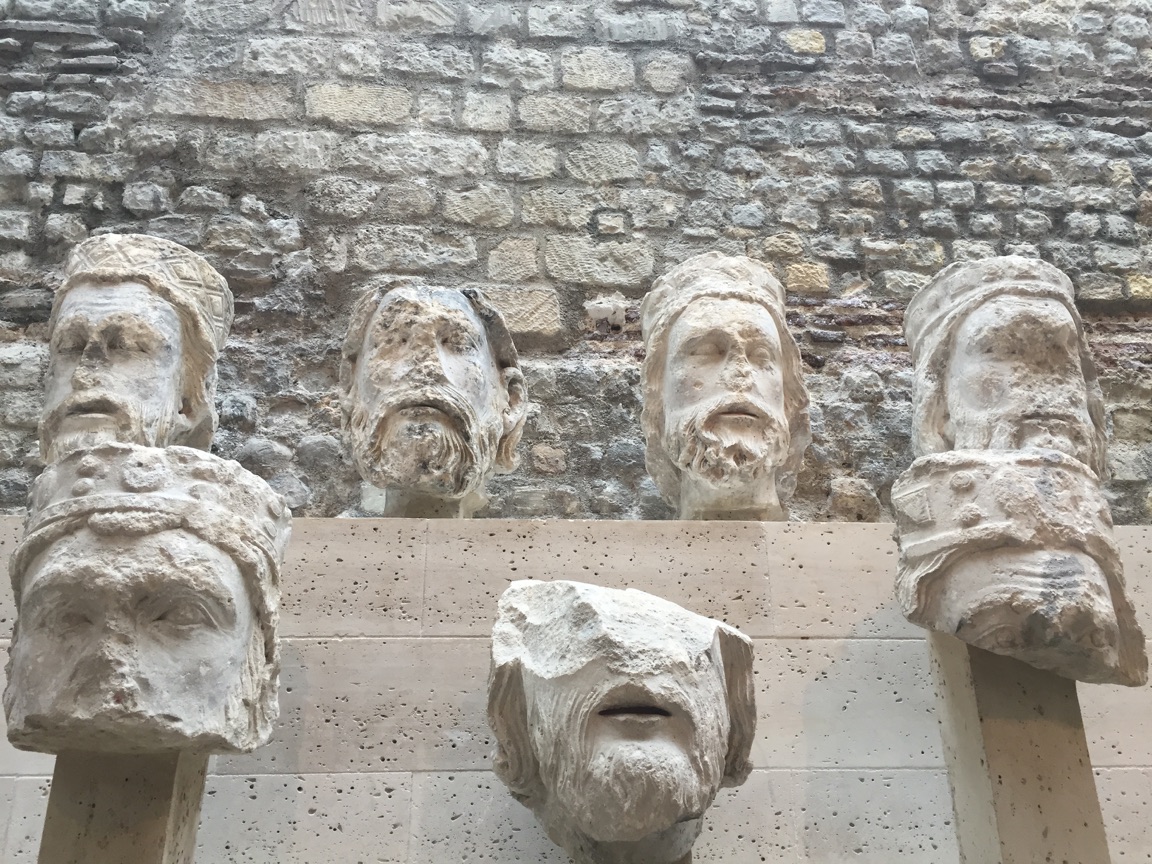
Musée de Cluny. Paris, France. © Jewel K. Goode, 2015. All Rights Reserved.


Musée de Cluny. © Jewel K. Goode, 2015. All Rights Reserved.


Musée de Cluny. © Jewel K. Goode, 2015. All Rights Reserved.

The Musée national du Moyen Âge, or Musée de Cluny, is located in the Hôtel de Cluny. The first establishment was constructed by Pierre de Chaslus after the acquisition of the ancient baths by the Cluniac Monastic Order in 1340. The selection of artifacts masterfully reflects the historical and metaphysical transformation of France. The weighted sense of socio-political, religious, and cultural obligations are complemented by the solemnity and relative darkness of the majority of the exhibition spaces. The wealth of artistic production including illuminated manuscripts, shields of armor, intricately woven tapestries, vibrantly stained-glass windows, reliquaries, and sculpture are all intimately bound to the Hexagone’s complex history involving war, conflict, religion, trade, society, and culture.

The Lady and the Unicorn tapestries (c. 1500) from the Château de Boissac were acquired in 1882, and are an example, par excellence, of medieval artistic production. The ensemble is comprised of a series of six wool and silk tapestries which reflect the beauty and charm of the mythical unicorn. Five of the six panels feature a representation of the five senses. However, the sixth panel, entitled “To My Only Desire,” is thought to evoke the sixth sense – the spiritual and moral center. The coat of arms with three crescents belongs to the Le Visite family. Although the subject is different in each, the content remains the same. Each tapestry has a deep pink background filled with delicately sprawling flowers, abundant fruit trees, and various animals including rabbits, goats, monkeys, and lions.  The activity between the Lady, the unicorns, and the animals always remains in the center of the tapestry, anchored by a lush green, oval zone.

The present town house was constructed during the second half of the 15th century. It was completed during the first half of the 16th century by the Jacques d’Amboise abbacy and follows a temporal construction: baths, medieval town house, and Couvent des Mathurins. Due to the unique implementation of the ancient Roman technique known as opus vittatum mixtum, the Hôtel de Cluny remains architecturally sound. Subsequent restoration and modifications were undertaken by Albert Lenoir (1801-1891) in the 19th century in order to help preserve the establishment. He had presented a project to create a historical museum that united the Palais des Thermes and the Hôtel de Cluny in 1832, with collections displayed in the buildings that housed them: antiquity in the frigidarium, Middle Ages in the Hôtel de Cluny, and subsequent periods in buildings adjacent to the Couvent des Mathurins. However, the destruction of these buildings in 1860 prevented the project from being realized.

The Musée de Cluny was conceived in the 19th century by Alexandre du Sommerard (1779-1842), magistrate at the Cour des Comptes (Court of Audit) and passionate art collector. At the end of his life, he had amassed an inventory of 1,434 objects. In 1834 he mused, “In 1832 the imagination of an art lover, who had long collected objets d’art from eras corresponding to that of the construction of the town house, gave him the idea of enhancing his collection with the harmony of the setting,” (Musée du Cluny: A Guide, p. 11). The Musée de Cluny opened in 1844 under the supervision of the Commission des Monuments Historiques with Alexandre du Sommerard’s son, Edmond, acting as its first director.

During his directorship, Edmond Sommerard made significant acquisitions, including the Lady and the Unicorn Tapestries (c. 1500), the Golden Rose (1330) by Sienese goldsmith Minucchio da Siena, the religious twenty-three scene Tapestry of Saint Stephen (c. 1500) which recounts the life of Saint Stephen and the movement of his relics from Jerusalem to Constantinople; and the hanging votive Guarrazar Crowns from Visigoth Spain (7th century). He also wrote the first museum catalogue which was successfully published and redistributed several times. Presently, the museum houses a vast collection of pieces spanning the ages: Antiquity, Romanesque art, Limoges work, Gothic art, and art from 15th century can all be found in the archives of the current establishment. However, due to the physical limitations of space, the Museum has had to reconfigure and re-conceptualize its collection. After World War II, Francis Salet and Pierre Valet limited its displays to thematically organized medieval works of art.

Author: Jewel K. Goode, Independent Curator, Photographer, and Educator

contact: jewelkismet@gmail.com

Sources: Musée du Cluny, Musée national du Moyen Âge: A Guide. Éditions de la Réunion des musées nationaux, Paris (2009).


Paris Reflections: Fall Edition N.3, Sainte-Chapelle

Paris Reflections, Fall Edition N.3: Sainte-Chapelle, Palais de la Cité

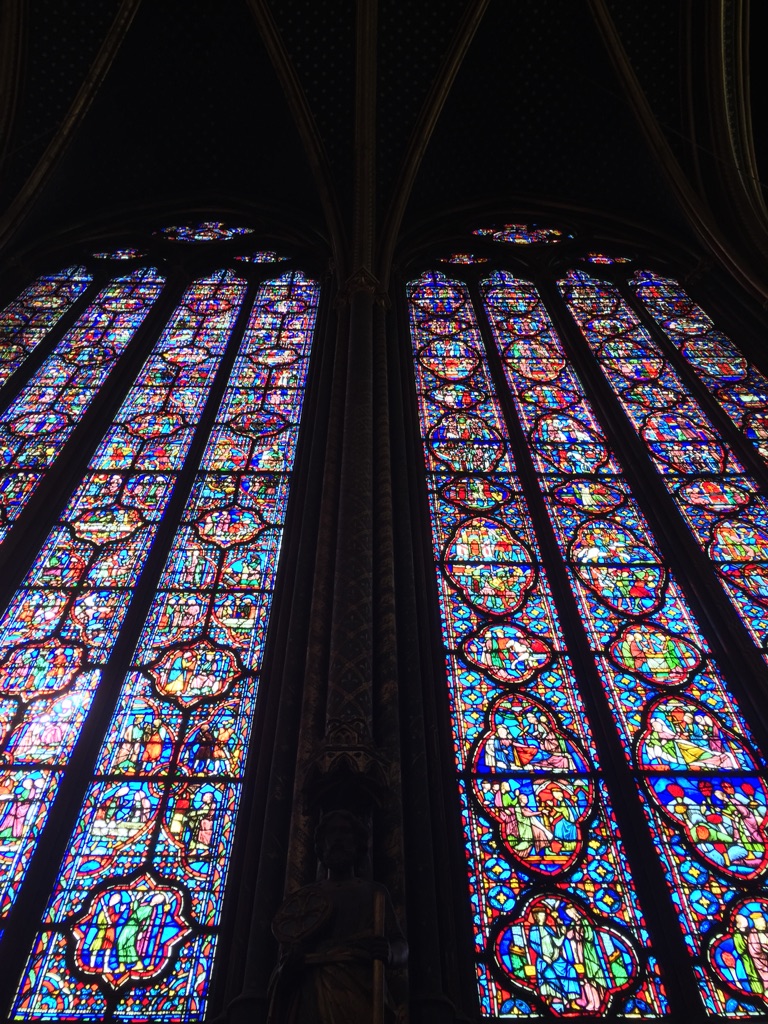
Sainte-Chapelle. Paris, France. © Jewel K. Goode, 2015. All Rights Reserved.

The Sainte-Chapelle is an example of Rayonnant Gothic architecture with its emphasis on verticality and architectural complexity. Elongated and vibrantly stained-glass windows, ornate gables, sumptuous interior, intricate ironwork, and elaborate goldsmithery all reinforce its structural elegance. The appearance of red, blue, and gold polychromy, as well as star patterns and fleurs-de-lis visible on the abacuses and vaulted ceilings add to Sainte-Chapelle’s general splendor and magnificence. It measures 36 meters long, 17 meters wide, and 42.5 meters in height, excluding the spire 33 meter spire which is adorned with apostles. The sheer amount of luminosity entering through the stained-glass windows serves as a direct metaphor for religious illumination and enlightenment sought by a pious population. Supporting buttresses adorned with gargoyles convey of sense of uniformity, as well as rhythm and movement to the entirety of the exterior complex. A giant rose window of the upper chapel prominently adorns the western façade.

The Carolingian reliquary was founded by King Louis IX (the future Saint Louis) in order to house his Holy Relics of the Passion. In 1239 Saint Louis purchased the Crown of Thorns worn by Christ for 135,000 livres. This religious and political act not only reaffirmed the monarch’s devotion to Christ, but it also solidified France’s powerful position in Western Christendom. Later, he also obtained a fragment of the True Cross from Baudouin II and other relics associated with the Passion, the Virgin Mary, and the saints. The artifacts have since been dispersed to other locations. The Gothic palatine reliquary chapel inspired subsequent holy chapels constructed by the monarch and his descendants. Sainte-Chapelle is all that remains of Saint Louis’s palace, along with part of the Tour Bonbec. It served as the royal residence for the Kings of France until 1370, housing the financial and judicial administrative seats of power.

Sainte-Chapelle has undergone a series of alterations and modifications beginning in the 13th century with Philippe le Bel. The 15th century and the Renaissance were no exceptions. In 1776 a fire ravaged the structure, destroying the Galerie des Merciers causing the subsequent demolition of the Trésor des Chartes. Severely damaged during the French Revolution, it underwent significant restoration between the years of 1840 – 1868. Following the precise guidelines of Viollet-le-Duc and his archeological studies, highly skilled architects successfully restored the Sainte-Chapelle to its former 13th century glory.

It is composed of two storeys of similar surface area, but of different heights. Each has a specific function. The upper floor rests at the same level as the royal apartments. It housed the relics and served as a special zone for the king, his entourage, and special guests. The lower floor housed the palace parish and was dedicated to Our Lady. It was a zone for the king’s soldiers, servants, and courtiers. Its low vault height of approximately 6.6 meters gives the chapel the impression of a crypt. Its central nave is 6 meters wide and is complemented by side-aisles measuring 2 meters which form the ambulatory. Small, interior buttresses are present, as well as 140 capitals – an architectural element typical in the 13th century Île-de-France region.

Author: Jewel K. Goode, Independent Curator, Photographer, and Educator

contact: jewelkismet@gmail.com

Sources:  Finance, Laurence de. The Sainte-Chapelle: Palais de la Cité. Éditions du patrimoine, Centre des monuments nationaux, Paris (2015).

Paris Reflections: Fall Edition N.2, Chantilly

Paris Reflections: Fall Edition N.2. Domaine de Chantilly. Musée Condé Exhibition: “Le Siècle de François 1er” (September 7 – December 7, 2015)

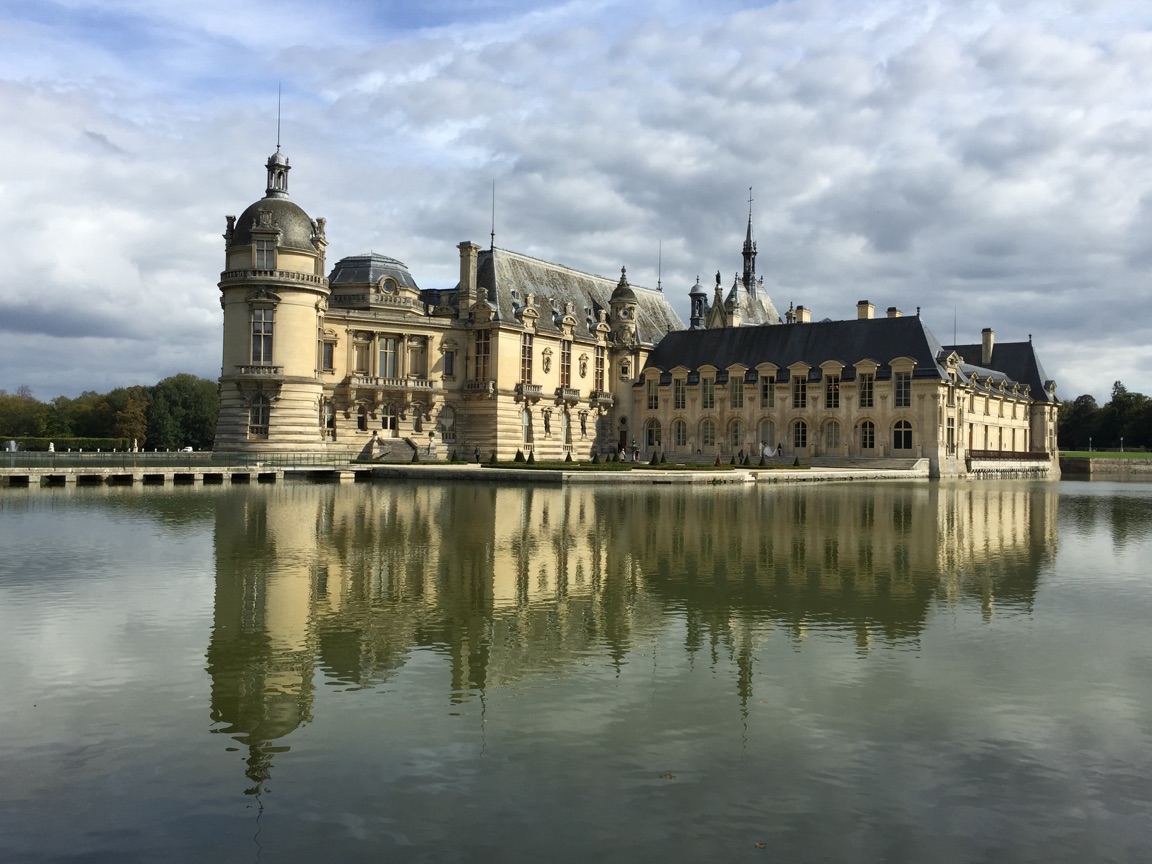
Château de Chantilly. © Jewel K. Goode, 2015. All Rights Reserved.

The exhibition, “Le Siècle de François 1er” (The Century of Francis I) is currently located at the Musée Condé in the Domaine de Chantilly from September 7 until December 7, 2015. It is a celebration of the 500th year anniversary of François 1er’s (1494-1547) ascension to the throne, and his victory at the Battle of Marignano in 1515. The exhibition, which is appropriately housed in the Salle du Jeu de paume of the Musée Condé, is an assemblage of 175 pieces and reflects the monarch’s profound interest in literature and the arts as seen in the multitude of paintings, architectural drawings, illuminated manuscripts, and decorative art objects. The exhibition expertly displays the interrelationship between socio-political and cultural aspects of French society with its choice of historical artifacts in an intimate environment. Courtly and family life are presented through the skillful artistic production of paintings and drawings by Jean and François Clouet, as well as an extraordinary collection of exquisitely bound books and illuminated manuscripts.

As a staunch patron of the arts, François 1er surrounded himself with scholars, humanists, scientists, scribes, and artists. Inspired by the innovation and intellectualism of the Italian Renaissance, the monarch often invited artists such as Francesco Primaticcio, Benvento Cellini, and Rosso Fiorentino, among others, to his court. The Domaine de Chantilly was inherited by Henri d’Orléans, Duke of Aumale, son of the last King of France, Louis-Philippe. It was bestowed upon him in 1830 by his godfather Louis-Henri-Joseph de Bourbon, the last Prince of Condé, and later bequeathed to the Institut de France in 1886. It is a vast estate and includes a Château with three expansive gardens spread over 115 hectares. The Château houses the second largest collection of antique paintings after the Louvre, and is the second largest library in France for illuminated manuscripts.

The neo-Renaissance style Château is comprised of the Petit Château, constructed in 1560, and the Grand Château. The latter had been destroyed during the French Revolution and subsequently reconstructed by architect Honoré Daumet between the years 1876 – 1885. An equestrian statue of the Constable Anne de Montmorency was erected in 1886 and is located on the terrace, facing the entrance. The entirety includes a chapel and urn containing the hearts of the Princes of Condé (17th century), an apartment complex for the Comte de Paris, designated museum rooms, and reception areas. The Domaine de Chantilly is also home to the elegant 18th century Grandes Écuries (Great Stables), designed by architect Jean Aubert. Its Musée du cheval (Museum of the Horse) boasts 200 works of art and decorative arts pieces, as well as equestrian events which are devoted to the art of haute-école horse training.

Author: Jewel K. Goode, Independent Curator, Photographer, and Educator

contact: jewelkismet@gmail.com

Sources: The Domain of Chantilly. Connaissance des arts (2015), H.S.N, No. 651/1.

Paris Reflections: Fall Edition N.1, Palais-Royal; Comédie Française; Pyramide du Louvre

Paris Reflections, Fall Edition N.1: Le Palais-Royal, La Comédie-Française, La Pyramide du Louvre

Musée du Louvre. Paris, France. © Jewel K. Goode, 2014. All Rights Reserved.


Palais-Royal. Paris, France. © Jewel K. Goode, 2015. All Rights Reserved.
Palais-Royal. Paris, France. Paris, France. © Jewel K. Goode, 2015. All Rights Reserved.

Palais-Royal: 8, rue Montpensier, 75001. Designed by architect Jacques Lemercier (1585-1684) in 1639

Originally known as Le Palais-Cardinal, Le Palais-Royal (or royal residence), acquired its name after the death of Cardinal Richelieu (1585-1642). Its stately façade is visible along rue Saint-Honoré, but claims an official address of 8, rue de Montpensier. Presently, it houses La Ministère de la Culture et de la Communication, Le Conseil d’état, and Le Conseil Constitutionnel. Designed by architect Jacques Lemercier (1585-1684) in 1639, the entire complex is reminiscent of neoclassical glory. Structural harmony and formal grandeur are produced with an emphasis on geometrical precision, symmetry, and monochromatic use of materials. The effect is reinforced with the repetition of solid columns, rounded arches, and refined pilasters topped with Corinthian entablatures. Structural levels and registers are vertically-horizontally delineated with the addition of delicate balustrades. Every element complements the other, thus creating visual balance.

Remnants of the La Galerie d’Orléans columns still exist, located between La Cour d’Honneur and Le Jardin du Palais-Royal. Fountains by Belgian sculpture Pol Bury (1922 – 2005) affectionately known as Sphérades due to their large, metallic spheres, and other temporary sculpture installations can also be found in the royal gardens. La Cour d’Honneur is an open, communal zone. It is home to the site-specific artwork by Daniel Buren, Les Deux Plateaux (1986) (or Les Colonnes de Buren) – striped black and white posts of varying dimensions. The interconnection between neoclassical and modern is prevalent here. There is a constant re-contextualization and reconfiguration of public space for contemporary society. Although Le Palais-Royal is historically steeped in exclusivity and elitism, all visitors are afforded the option of strolling through the tree-lined gardens, as well as the colonnaded arcades filled with electric lamps, contemporary galleries, fashion boutiques, and an assortment of restaurants including Le Grand Véfour.  First opened in 1784 by Antoine Aubertot, it was later purchased by Jean Véfour in 1820.

Comédie-Française: 2, rue de Richelieu, Place André-Malraux, 75001. Salle Richelieu, designed by architect Victor Louis (1731-1800) in 1790.

La Comédie-Française is an elegant, three-century old institution located on 2, rue de Richelieu. Located adjacent to Le Palais-Royal, it exudes a formidable aura. Salle Richelieu, site of the present La Comédie-Française, was designed by architect Victor Louis (1731-1800) in 1790. Stately columns, delicate balustrades, elegant arches, and refined pilasters with ornate entablatures add to the structure’s formal composition. Its façade complements that of Le Palais-Royal with its visual symmetry and concise delineation of space, clearly visible with its vertical and horizontal registers. Founded by Louis XIV in 1680, La Comédie-Française was the result of the merging of two theatrical groups of the seventeenth century: Théâtre Guénégaud and Hôtel de Bourgogne. A total of twenty-seven were actors were chosen specifically by Le Roi-Soleil.

The establishment, part of Le Palais-Royal complex, is formerly known as Le Théâtre-Français and La Maison de Molière, after renowned playwright Molière (1622-1673), né Jean-Baptiste Poquelin. The company, which had a repertory of writers including Molière, Corneille, and Racine, held a monopoly over performances in Paris until 1790. The original association of actors included, among others: Jeanne Beauval, Hubert de Croisy, and Armande Béjart. The establishment has been located at its present site, Salle Richelieu, since 1799, and has undergone several enlargements and modifications over the years.

Pyramide du Louvre: Palais du Louvre, Cour Napoléon, 75001. Designed by architect I. M. Pei (1917 – ) in 1989.

Finally, the controversial La Pyramide du Louvre was designed by Chinese architect I. M. Pei (1917 – ) and is centrally located in La Cour Napoléon of the Le Palais du Louvre. Commissioned by French President François Mittérand in 1984, it was completed in 1989. The imposing metal and glass structure has a base of 35 meters and stands nearly 22 meters tall. It serves as a main entrance to Le Musée du Louvre, and is surrounded by a water feature in addition to three smaller pyramids. An inverted pyramid accompanies the entirety of the complex, and serves as a skylight for the Carrousel du Louvre shopping district located directly below.

Critics of the structure have argued that its hyper-modernity in use of materials exists in direct contrast to the classical, symmetrical, and visually-balanced Palais du Louvre. Harsh, severe angles created by the glass structure create a prominent juxtaposition against Le Palais du Louvre. However, opponents note that the complexity of architectural components reflect France’s dynamic, historical trajectory which encourages provocative discussion, inspires innovative techniques, and stimulates creativity among its population. The juxtaposition of neoclassical elements with modern elements creates a modern, fresh association that is constantly evolving. This is executed by promoting thoughtful expression, respect, and appreciation cross-culturally in an ever-expanding expanding globalized community. In the twenty-first century, most would agree that La Pyramide du Louvre is the embodiment of a transformative French nation par excellence; one that cherishes past endeavors, but fully embraces future possibilities.

Author: Jewel K. Goode, Independent Curator, Photographer, and Educator

Contact: jewelkismet@gmail.com

Sources: La Comédie Française: www.comediefrancaise.fr; Wikipedia Louvre Pyramid: https://en.wikipedia.org/wiki/Louvre_Pyramid; Wikipedia Palais-Royal: https://en.wikipedia.org/wiki/Palais-Royal


Interview with Russian Artist Oleg Sheludyakov

Interview with Russian Artist Oleg Sheludyakov

Oleg Sheludyakov

Russian artist Oleg Sheludyakov was born in 1971 in Novosibirsk, Siberia and attended Kaleidoscope Art School.  At the age of 17, he began his studies in Architecture at the Novosibirsk Engineering Institute. In 1995 he graduated with a degree in Philosophy and Humanities from Novosibirsk State University. He later studied monumental painting at Novosibirsk Fine Arts and Architectural Academy and drawing at the Fine Arts Academy in Saint Petersburg, Russia.  He has been a member of the International Federation of Artists and National Creative Union of Russia Artists since 2001.

Sheludyakov has been an active art professional for fifteen years, based primarily in Nice, France and never had any other career aspirations before becoming a painter.  Although he was raised in a highly intellectual Siberian city known for its scientific achievements and advancements, the artist believes that any academic diplomas, degrees or certificates he previously obtained have not played a significant role.  Instead, he insists that the practical skills he has acquired over the years have been the most important factor in his artistic process.  For Sheludyakov, conceptualizing and preparing a specific work of art is a fluid, flexible process.  His atelier, or studio, is located in his apartment.

However, he dreams of opening his own fine art gallery in the future, especially since the art world in Nice, France is quite rigid – everything is extremely structured.  In order to gain success, he stated that artists must associate themselves with a particular group or society.   Such rigidity in the system makes it difficult to work as an independent artist.  Conversely, the process is more flexible in Novosibirsk where he is more well-known and respected.  This is due to the strong family and community ties he continues to nurture even though he resides on the Côte d’Azur in southern France.  In addition, he believes his style is perfectly suited to the local tastes of his native city.  Unfortunately, the Siberian city lacks a solid art market – it is virtually non-existent.  Perhaps this is due to its geopolitical isolation; its relative location being far removed from the world’s great art markets in New York, Beijing, and Berlin.

In order to attract interest for his work, Sheludyakov often prepares painting and drawing workshops in his atelier.  Despite increased advances in public relations and social media marketing methods, the painter has limited interaction with other international art professionals and shuns current trends in the art world.  He was influenced by other artists, writers, architects, and designers many years ago, but now relies on the immediacy of his environment for inspiration.  The artist is reluctant to utilize Facebook and Twitter as a vehicle to promote his work.  Instead he relies on alternate methods of artist-gallery channels of communication.  This uncertainty about social media is proving to be difficult in an age of continual news feeds and instant status updates.

The lack of an official agent or manager also impedes his progress, somewhat.  In addition, it is sometimes rather difficult retrieving your work after an exhibition, since some gallery owners lose both interest and motivation to return borrowed items afterward.  However, there are many advantages of working as an independent artist.  Sheludyakov is able to confront the “metaphysical side of reality” every day.  He is an avid reader, amateur photographer, and enjoys the cinema and traveling.  He appreciates feminine beauty and attempts to magically translate that love onto a canvas or linen, his preferred medium.   When asked if his work as a particular message or theme, his response was quite simple: “Enjoy life.”

Shelduyakov has had exhibitions in more than 25 countries, including Russia, France, Italy, Germany, and England. His works are included in the art collections of Novosibirsk Art Museum, The House of Scientists, Siberian branch of the Russian Academy of Sciences, as well as in various public and private collections around the world. His most successful exhibitions have been in Crete, Hamburg, and Novosibirsk.  The least successful was in Washington, D.C. five years ago.  He explained that an artist must fit the tastes of the local environment, and should be able to deal with professional gallery owners and art curators.  Recent exhibitions have been in Duisberg, Germany and Novosibirsk, Russia (2012), a group exhibition on the Côte d’Azur (April 2013), and a solo exhibition in Novosibirsk (2013).

Note: The artist currently resides in Blois, France.